




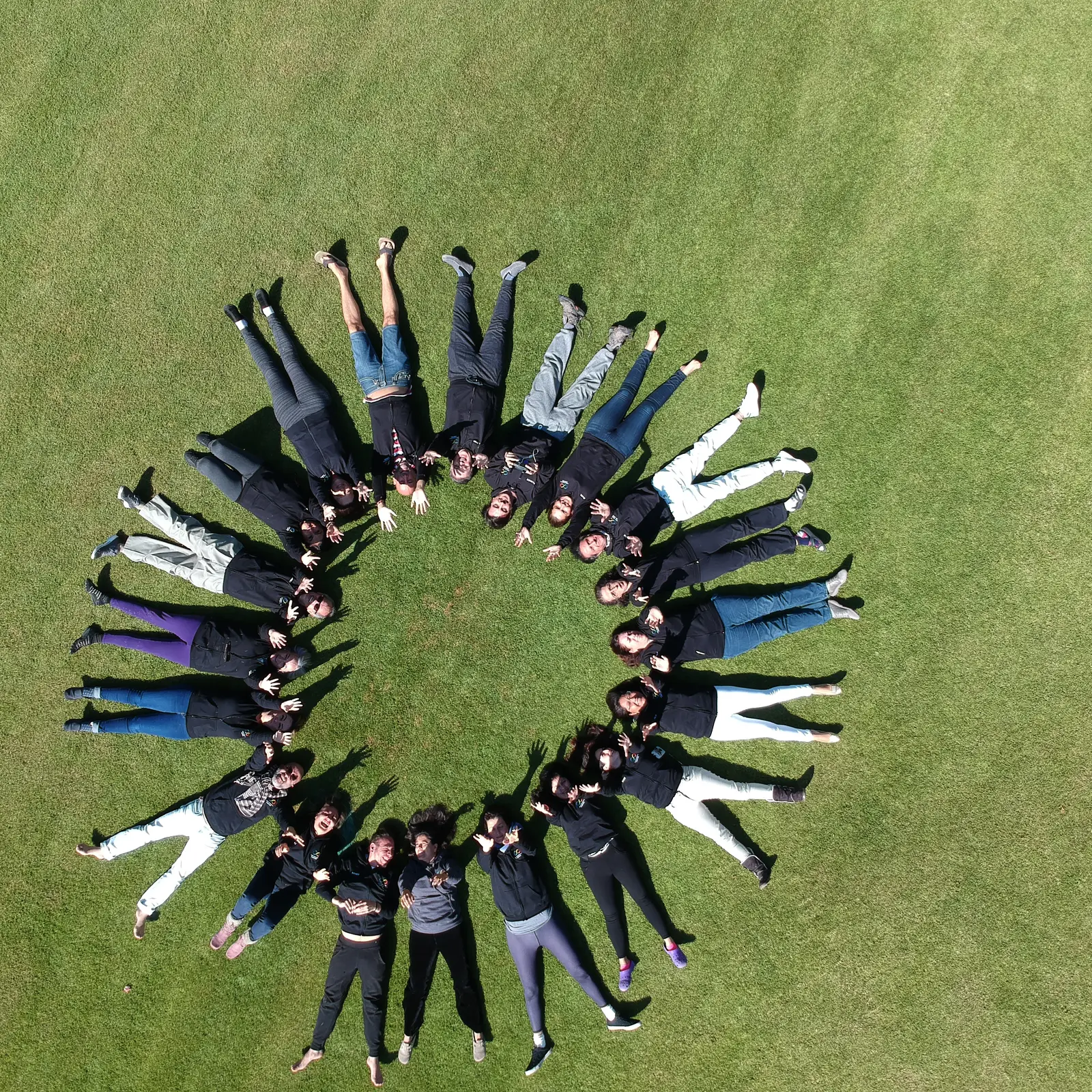
There are questions the mind can't answer on its own. Why do I shut down whenever someone gets too close? Why is it hard to breathe deeply when there's conflict? Why, despite perfectly understanding what's going on with me, do I keep repeating the same patterns? The answer, often, isn't only in thought — it's in the body. And for this, Core Energetics proposes a path of exploration.
From Reich to Pierrakos: the body as an emotional archive
Core Energetics has a clear genealogy. Wilhelm Reich, a psychoanalyst and student of Freud, was the first to propose that psychological defenses aren't only mental: they install themselves in muscle tissue, in restricted breathing, in posture. He spoke of the muscular armor and of a characterological armor — an armor the body builds to protect us from what was too much to feel, and that ends up expressing the totality of our history.
Years later, Alexander Lowen took up that legacy and developed Bioenergetics, a form of therapeutic work that integrated movement, voice, and grounding — the body's connection with the earth, with reality — as central tools of the process. But it was John Pierrakos, co-founder alongside Lowen and a foundational figure in this tradition, who took the next step: integrating that vision of the energetic body with a spiritual understanding of the person. Influenced by the teachings of the Pathwork — a path of inner development born from the channelings of Eva Pierrakos — he understood that healing didn't mean only feeling better psychologically. It meant reconnecting with the Core: the creative energy/consciousness of life manifesting in each person, that dimension of being that remains intact beneath all the wounds. Pierrakos said it without metaphors: "The journey of the soul on earth is an adventure and takes many lifetimes."
The process Core Energetics proposes has four stages: becoming aware of and moving through the Mask — the facades with which we present ourselves to the world —; purifying the Lower Self — the part of us that says "no" to life and creates from the intention of separation, of division, of rupture —; grounding the Higher Self — the part that says "yes," that chooses connection with humanity and with life, accepting imperfection and letting go of demands and shoulds —; and, finally, unveiling the Universal Plan of Life: building a vision of our transcendent purpose on this earth from our qualities and our resources. A bridge, in sum, between the body, the psyche, and the spiritual dimension of human experience. The very name of the Pathwork announces it: the path is the work, and the work is the path.
A living lineage
Core Energetics isn't learned from books. It's transmitted through the body, in relationship and in resonance, in community — and, in Córpore's approach, with empathy, congruence, and unconditional positive regard. From the Institute of Core Energetics in New York — the main seat, where it all began, founded by Pierrakos — this tradition has spread across the world through those who studied directly with him or with his first generation. Anna Timmermans, trained by Pierrakos himself, founded the Netherlands Institute of Core Energetics (NICE); her book Beyond Defence is a reference on the modern techniques of character work. Erena Bramos founded the Institute of Core Energetics Greece. Kate Holt was the first woman to direct the New York institute, and continues teaching internationally.
And in Mexico, Jorge Galindo — who also trained with Pierrakos, whom he calls his teacher — founded and directs Instituto Córpore, whose training is certified by the New York institute. His book, Viaje al centro del cuerpo y la mente: psicoterapia corporal y sistemas de carácter (Journey to the Center of the Body and the Mind), systematizes the five characterological systems of adaptation — and the term itself takes a stance: where the tradition said defense, Jorge proposes adaptation, because each character was, before being a problem, the best solution we found in order to survive. I know this closely: I had the privilege of editing that book, and we've reprinted it three times already.
I like telling this history, and also speaking of its protagonists: of how this work has spread throughout the world thanks to different voices. And I tell it, moreover, because I had the honor and the good fortune of learning from them.
My path through Córpore
I arrived at body-based therapy in 2012, in growth groups with a body-centered approach. There I fell in love with something that still sustains me as a therapist: the possibility of witnessing another person's transformation. I would watch someone move from emotion to vulnerability, and from vulnerability to something new, and I asked myself again and again: how is that done? How do you accompany someone through what the body has kept stored?
That question led me, in 2015, to Instituto Córpore. Module by module, each teacher marked me in ways I'm still discovering. With Jorge Galindo the journey began: energy and consciousness. With Graciela Contreras I worked the schizoid and oral characters, and later, through her teachings in vegetotherapy and Reichian unblocking, I came back to Reich and worked with the nervous system for the first time. With Lety Zonana I studied psychopathy and, later, ethics. With Rogerio Canto — my therapist for two years and a dear friend, whom we lost during the pandemic — I worked the masochistic and rigid characters, and learned something few know how to teach: firmness placed in the service of growth, with the desire to care and without the desire to hurt. With Adriana Hoyos and Roge himself I encountered holotropic breathwork, my doorway into the transpersonal. With Anna Timmermans, roller work and characterology. With Loly Sierra, founder of Kumaris, subtle energy — I allowed myself to see with my eyes closed, to see with the heart. With Erena Bramos I worked the Lower Self and learned detachment and no-drama as a therapeutic stance; her phrase "we are one energy" stays with me to this day, as does the process I did with her: giving voice to my inner demons until I could take charge of my most fragile parts. And with Lisa Loustanau I worked the Higher Self — she was the first teacher I ever saw apologize in front of the group for a sarcastic comment; that lesson in humility was worth as much as any technique. In the postgraduate program I kept learning: sexuality with Lisa, group work with Erena, and working with symptoms with Ken Goldberg.
And then there's Jorge. I met him before becoming his student, marching for Ayotzinapa, shouting "¿dónde están?" — where are they? — among thousands of voices. It marked me to see that a therapeutic authority also marched, also questioned, also got involved. In his company I have given new meaning to my relationship with loving male figures — no small thing in a field where therapeutic spaces are usually held almost entirely by women. From him I learned about energy and consciousness, the Mask and the Lower Self, work with imagery, transference, and facilitation tools from the person-centered approach — and a way of leading in which all my questions have been heard and given time to settle before receiving an answer. I was his assistant, then his shadow as a junior teacher, and today I have the joy of being a lead teacher at Córpore: of sharing the light that he — that all of them — planted in me.
A process of purification of the soul
If I had to say what the Core process is for me, I would use the words you'll find in Jorge's book: it is a process of purification of the soul. It isn't the only one that exists, nor was it the last one I did. But it is the deepest I have done in a group — and that is no small detail. That journey into my inner world would not have been possible without my generation, because it is in our relationships that we transform: being and accompanying one another as a group, showing ourselves in order to transmute within the group.
That process helped me make peace with some of my demons and recognize how far I can go in causing harm. It no longer surprises me when someone lets me know that something I said or did hurt them — not because I don't care, but because I recognize that I am capable of harming, and that recognition is precisely what allows me to be ever more careful. Core Energetics doesn't make you harmless: it makes you responsible, and it continually invites you to see life as a process of co-construction, in which you hold a good part of the capacity to build your own reality.
It also allowed me to build a relationship with spirituality from experience, not from dogma. I can trust life and feel held by it. I can dare to think that we are more than a body, a mind, and an energy quantifiable in watts. And feeling supported by life has taught me to allow more and force less — to hold the expression of others, to hold myself, and to offer holding as a therapist.
What the body doesn't forget
I work with this every day in my practice. A sunken chest can speak of a sadness that was never cried — maybe because there was no space, maybe because no one could contain and hold it in that moment. A permanently clenched jaw can be the imprint of an anger that found the door closed too many times. A back that curves under an invisible weight can be the physical record of having taken on, very early, a responsibility that wasn't yours.
The body, in its posture, its mobility, and its vitality, always speaks of our emotional and psychic history.
From my teachers I learned that approaching the body in therapy isn't a technique: it's an act of active, patient listening — a dialogue, really. The work includes movement, voice, breath, grounding, and above all presence — the willingness to accompany what emerges when energy begins to move where it was blocked. It's not about forcing anything, but about creating the conditions for the nervous system and the body to remember there's another possibility. That things can begin to be another way.
This process connects naturally with other approaches I use in practice. Somatic Experiencing works with incomplete activation cycles that also live in the tissue. Polyvagal Theory offers a very useful clinical model of how the nervous system regulates — or loses regulation — in response to the environment. Body-based therapy as a broader field shares with Core Energetics the conviction that the body is always a valid entry point, sometimes the most honest one. And IFS (Internal Family Systems) sees the personality as a series of parts, recognizing the observing self — the energy of the Higher Self — as an element of the conscious self.
The deeper question
Some people come to therapy seeking relief — and that is completely legitimate. But others arrive with a different, broader question: who am I beyond my wounds? What remains when I stop carrying what was never mine? In Core, that question has a formulation I turn to because it lets me be moved and, above all, because it facilitates the expression of the soul's longings: what is the deep longing of your heart?
Pierrakos understood that therapeutic work, at its deepest level, could lead us to contact a broader dimension of existence. Not through religion, but through the opening of the heart that happens when the armor — muscular and of the personality — softens and gives way to the essence of the spirit. In the Pathwork tradition this is named the Higher Self: that part of us aligned with our evolutionary and transcendent sense, connected to life, that was always there.
In my therapeutic process I don't impose this lens. I always work by allying myself with each person's desire to move toward life, but I don't make it explicit — or tacit — for those who aren't interested in seeing themselves through it. My references are usually basic: the body, its sensations, the instincts of survival and self-protection and, most importantly, what matters to each person and the symbols they find meaningful.
What I have found, again and again, is this: every chronic tension is also a form of self-love misdirected. The body did the best it could with what it had. The armor you built protected you — it was your best adaptation. The work isn't to destroy it: it's to gently ask it whether it's still necessary. Something we also do, by the way, in IFS.
Healing, from this perspective, isn't fixing something broken. It's a way of seeing we share with Somatic Experiencing: not blaming, not retraumatizing, not revictimizing — with one eye on the resources and capacities already present, and the other on extending a compassionate hand to our incomplete processes, our pending tasks, our capacities yet to develop, and our realities yet to integrate. It's recovering the vitality that was interrupted. It's coming back to inhabit yourself.
If you're drawn to a process of transformation in community, integrating body, mind, heart, and spirit, I recommend visiting Córpore's website to learn about their training in body psychotherapy. And if you'd like to explore how this work could be part of your individual process, you can read what to expect from therapy or write to me directly for a first conversation.