




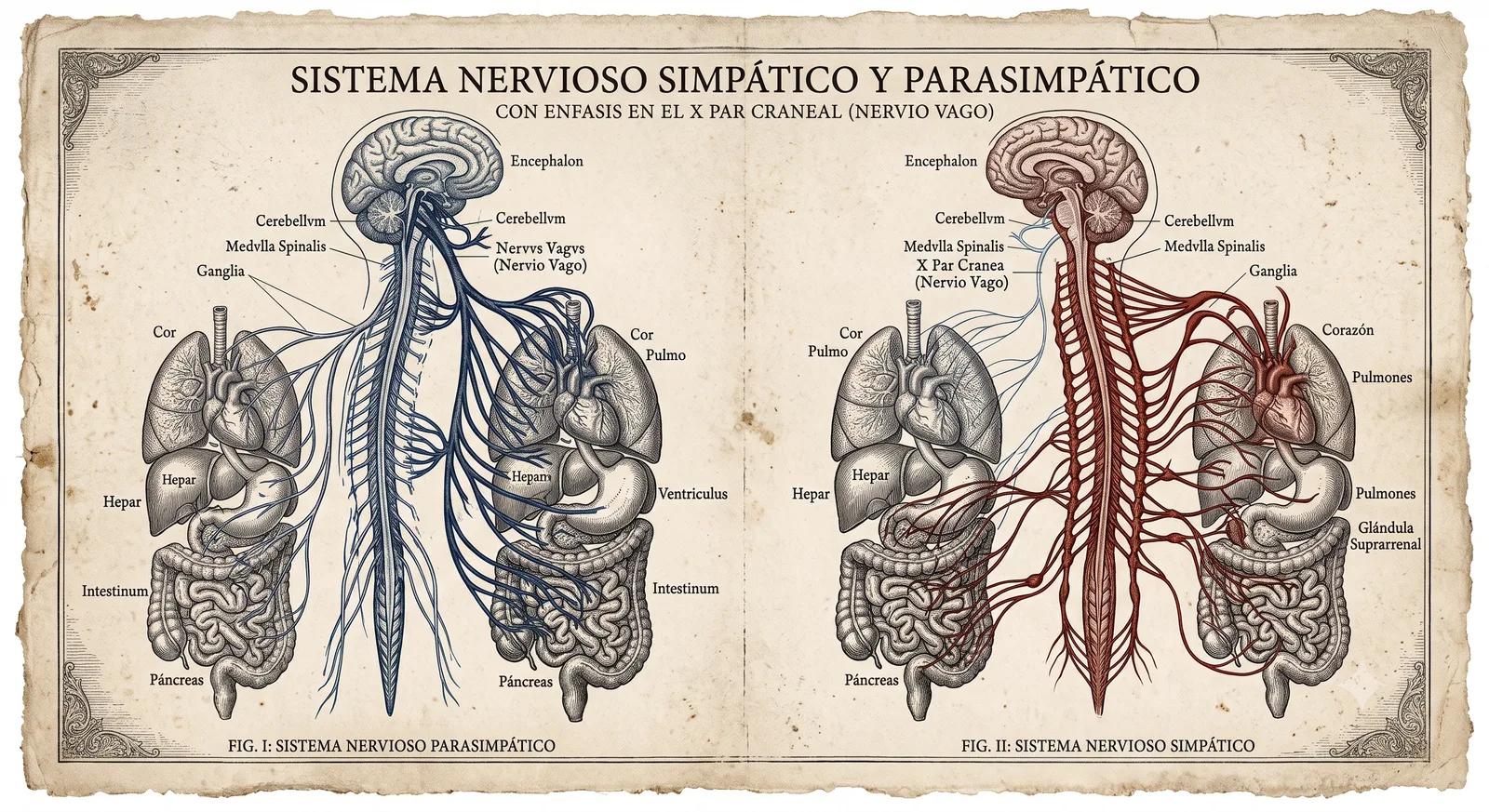
There are moments when we react in a way we later don't understand. You "freeze" in the middle of an argument and can't think. Your body collapses at a memory even though you rationally know it's over. You disconnect in situations that should feel safe. You're not exaggerating, and you're not too sensitive: your nervous system is doing exactly what it learned to do to keep you alive. Polyvagal Theory, developed by neuroscientist Stephen Porges, offers a map for understanding this — and that map changes how you see yourself.
Three circuits, three ways of relating to what surrounds us
Porges described three evolutionary circuits in the autonomic nervous system, each with a distinct function and its own evolutionary history.
The oldest is the dorsal vagal circuit: it was the first to appear in evolutionary history — we share it with the simplest vertebrates — and at the neuronal level it's marked by the absence of myelin. When this circuit has a predominant tone, it generates a state of immobilization, of disconnection. When the threat is so overwhelming that the nervous system concludes there's no way out, the organism shuts down. In daily life this can look like dissociation, emotional numbness, deep exhaustion, or that sense of "being gone."
The second is the sympathetic system: the circuit that enables, promotes, and channels energy toward mobilization. Fight or flight. It's the accelerator — the state of alertness, adrenaline, urgency. Very useful when there's real danger; problematic when it fires in situations that don't call for fighting or fleeing. Chronically, it's what keeps hypervigilance running.
And the most recent is the ventral vagal circuit, the one that appeared with mammals. When this circuit has a predominant tone, we feel present and connected — we can learn, assimilate, digest, create, bond, reflect. It's the state where the voice regulates, the gaze softens, the body breathes. The state where life, in its fullest sense, is possible.
The key to the theory is this: we don't consciously choose which state we're in. The nervous system constantly evaluates the information it receives from the environment and from the body itself — through the senses and a rich, complex neural network — vocal cues, tone, movement, space. And it activates whichever circuit it considers appropriate. Porges calls this process neuroception: a perception that happens below the threshold of consciousness, before there's time for a thought to emerge.
Why the therapeutic relationship isn't just the "container" — it's also the intervention
This has enormous implications for understanding how body-based therapy works — because there's no such thing as "polyvagal therapy" as such, only therapeutic interventions that draw on Polyvagal Theory. It's not enough to talk about what happened if the nervous system is still experiencing threat cues in the present moment.
Activation states have their own hierarchies and logic. Sympathetic and dorsal activations are "louder" and become more prominent than the ventral state: the system will always try to eliminate or flee any threat before allowing itself to settle into connection and rest. That's why learning and digesting experience remain conditional on the fight-or-flight and freeze-or-dissociate circuits being only lightly activated. Genuine reflection, shifting perspective, reconnecting with yourself — all of that first requires a degree of safety in the nervous system.
That's why the therapeutic relationship isn't just a frame within which the work happens. It is, in itself, the first intervention. Deb Dana, a clinical psychotherapist closely aligned with Porges, has translated his theory into concrete interventions in an extraordinarily accessible way, and she puts it clearly: co-regulation is the foundation of all regulation. When a person's nervous system perceives safety in the presence of another — in the rhythm of the voice, the quality of listening, the consistency of the frame — it becomes possible to contact experiences, memories, and possibilities that would otherwise remain inaccessible.
In my practice, everything is shaped by these principles: from the care I take with predictability — so you know what's going to happen, based on our agreements and on informed consent — through the lighting and physical elements that make up my office, to the pace and speed of our work, which we build together, in co-regulation.
A map that connects to many paths
Polyvagal Theory isn't just a conceptual framework: it's a practical map that illuminates what happens in many other therapeutic approaches:
Peter Levine's Somatic Experiencing works with activation cycles that were left incomplete — the organism that couldn't finish defending, fleeing, processing. From the Polyvagal lens we can describe what's happening: the nervous system got stuck between sympathetic and dorsal, never reaching resolution. And yet, we're careful not to offer linear explanations — this happens to you because of that — because transformation and growth don't always follow cause-and-effect recipes. Levine and Porges speak fluently to one another.
Internal Family Systems (IFS) describes "parts" that activate under different circumstances. Many of those parts are, in polyvagal terms, automatic protective responses — parts that learned to function from the sympathetic or from dorsal disconnection, and that don't yet know the danger has passed.
Bessel van der Kolk, whose research on trauma has reshaped clinical understanding over the last decades, arrives at similar conclusions: the body keeps the score — as the title of his best-known book puts it — and treatment has to include the body. Pat Ogden, through Sensorimotor Psychotherapy, works directly with the bodily impulses that were left interrupted — another way of talking about the same regulation process.
Body-based therapy as a broader field shares — ideally — the same underlying premise with the Polyvagal model: the nervous system lives in the body, and it's from the body, more than from analysis, that real change takes hold. I say "ideally" because, although we come from Reich, authors like Lowen and Pierrakos didn't pay as much attention to subconscious or involuntary physiological processes; today, from a trauma-informed lens, the Core community itself has begun questioning how to integrate this, recognizing that our techniques can even exceed the nervous system's own tolerance thresholds. That's a discussion about retraumatization I'll take up in another piece.
Compassion as a natural consequence
There's something I find deeply liberating in this theory, and that I try to convey in session when it's useful: you're not irrational when your body reacts in ways that are disproportionate or out of context. You're not broken. Perhaps your nervous system got used to something, at some point, that made sense for the challenging circumstances you were living through then — or for the season when that habit got fixed in place. And it keeps applying it because no one has shown it yet that the conditions have changed.
Approaching the nervous system through the lens of Polyvagal Theory is a process of attuning to and becoming familiar with each of its states. Deb Dana, in her book Anchored, suggests thinking of each state as weather: for someone, a lot of disconnection might feel like a desert landscape, cloudy, starless, at night; for someone else, ventral predominance might feel like a warm, gentle breeze; and sympathetic activation, like a hurricane arriving. Getting to know your own nervous system isn't an intellectual exercise: it's not about knowing the theory, but about learning to recognize what state you're in and developing a kinder, more curious relationship with your own responses. That's the beginning of self-compassion: not as an abstract ideal, but as a concrete practice that begins in the body.
A gift of immersing ourselves in these landscapes, of becoming familiar with the states of the nervous system and opening ourselves to experiencing the transitions between them, is that we start discovering paths out of freeze, out of fight and flight, and back to presence, to connection — to what I like to call coming home. As we travel these paths back and forth, again and again, we become able to be and to resolve things in ways different from what we've known. Not all at once, but gradually, genuinely, and verifiably: because our resilience emerges along the way.
If you'd like to understand better how I integrate this perspective into therapeutic work, you can read about what a first session is like or about what to expect from therapy.
References
- Dana, D. (2018). The Polyvagal Theory in Therapy: Engaging the Rhythm of Regulation. W. W. Norton & Company.
- Dana, D. (2021). Anchored: How to Befriend Your Nervous System Using Polyvagal Theory. Sounds True.
- van der Kolk, B. (2014). The Body Keeps the Score: Brain, Mind, and Body in the Healing of Trauma. Viking.